
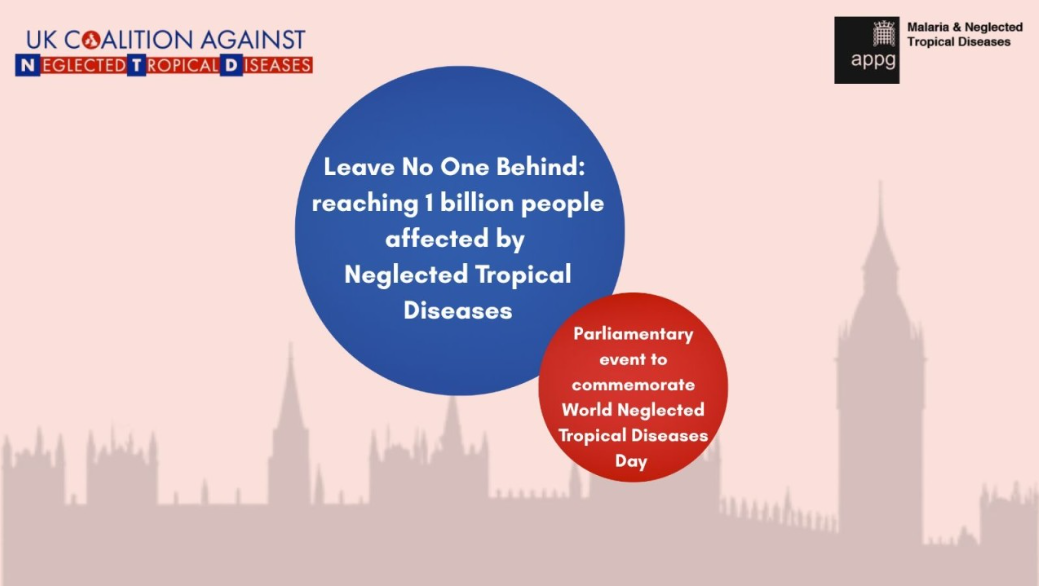
The event brought together Parliamentarians, global health leaders, researchers, people with lived experience, and civil society, calling on the UK Government to reaffirm and strengthen its leadership on NTDs.
Speakers highlighted that integrating NTD prevention, diagnosis, and care into essential health services—alongside predictable, transparent funding for research and implementation—is vital to ensure that the world’s most marginalised populations are not left behind.

Dr Lauren Sullivan MP, Co-Chair of the APPG, opened the event by stating:
“NTDs affect over one billion people globally. These 21 preventable and treatable diseases and conditions trap people in cycles of poverty, thriving among some of the most isolated and marginalised communities.
But progress proves what’s possible. Guinea worm cases have fallen from 3.5 million to just 10 last year, and sleeping sickness cases dropped from 40,000 annually to fewer than 600 in 2024. Sustained investment really works.”

Guests and speakers included The Rt Hon Baroness Chapman of Darlington, Minister for International Development and Africa, as well as representatives from the World Health Organization (WHO), industry partners, academics, civil society organisations, and advocates across sexual and reproductive health, nutrition, and One Health.
In a significant announcement, Baroness Chapman confirmed £3 million in new UK funding for operational research on NTDs. The investment will support work on female genital schistosomiasis (FGS), migrant health, and strengthening health systems for NTD service delivery. She added:
“We can do research, we can do programming, we can share best practice, and share our expertise. But this has to be African-owned, African-led, and African delivered. That’s how you get the sustainable long-term change that really makes a difference.
We’ll support research work on integration and understanding how NTD interventions can work with and strengthen countries’ health systems. This will also extend to work in FGS. I’m very pleased that we’re able to support that, which so profoundly affects the lives of so many women.
We are alongside you, and we want to continue to work incredibly closely with you. We value enormously the innovation, the leadership, and the approach that you take, which I think we can learn so much from in other areas of development.
The event showcased a powerful video with testimonies from people affected by NTDs.
Via video Dr Daniel Ngamije Madandi, Director of Malaria and NTDs at WHO, stated:
“I would like to highlight the UK’s commitment to NTD elimination. As of today, fifty-eight countries have eliminated at least one NTD, certainly as a result of strong local-leadership and ownership, and in many cases with support from the UK.
Achieving the NTD roadmap targets will require keeping commitments, expanding partnerships and taking collective action which prioritises both the global health agenda and national health systems in this changing world.”

Professor Julian Eatonof the Liverpool School of Tropical Medicine launched the new WHO Essential Care Package to address Mental Health and Stigma for people with NTDs, marking an important step toward integrated, person‑centred care. He highlighted:
“We’re really delighted that today we launched this WHO guideline. I encourage you all to see how it can be integrated into all your programmes. Not only will that have an impact on the emotional well-being of the people affected by NTDs, but we are pretty confident it’s a really important foundation for the elimination of the diseases that we’re all working towards.”

Dr Belete Legesse (PhD), Head of Medicinal Chemistry at CDT‑Africa (Addis Ababa University), underlined the importance of long‑term UK research funding:
“NTDs remain chronically under-prioritised in diagnostics and drug development. The dominant global R&D model relies heavily on market-driven incentives, which rarely work for diseases with limited commercial return. We cannot expect industry alone to solve this problem.
Continued UK leadership can ensure that diseases long neglected are finally addressed—and that innovation is brought closer to the communities who need it most.”

Dr. Borna Nyaoke-Anoke, Head of Mycetoma Disease at Drugs for Neglected Diseases initiative (DNDi), called on the UK government to accelerate progress through three commitments:
“Champion integrated, women‑centred NTD programmes; invest in end‑to‑end innovation for new tests and treatments; and support climate-smart, One Health surveillance and integrated planning.
NTDs must become neglected by no one. We have the tools, the science, and the partnerships and research talent in countries hit hardest by NTDs. What we need now is the will.”

Closing the event, Dr Wendy Harrison, CEO of Unlimit Health, emphasised that integration is the key to sustainable, equitable progress:
“Integration isn’t optional —it’s the pathway to achieving health for all.
When we diagnose female genital schistosomiasis during a routine reproductive health visit, we prove our systems work for everyone. When a child receives vaccinations, nutrition support, and deworming in one visit, we demonstrate that comprehensive care is possible.
She also celebrated the young finalists of the Light a Path poster competition, co‑organised by Unlimit Health and The Leprosy Mission, which encourages greater understanding of NTDs among UK children and young people.

As the UK Government prepares for the upcoming Foreign, Commonwealth and Development Office Future of Development Conference, this event underscored how coordinated action across global health, research, and development sectors can strengthen the impact of UK aid, ensuring communities affected by NTDs are not only reached, but prioritised.
About the UK Coalition Against NTDs
The UK Coalition Against NTDs is a collaborative partnership between UK organisations, coalitions and special interest groups actively engaged in the control, elimination or eradication of NTDs. Members include Martha Varney from the APPG on Malaria and NTDs, the International Coalition for Trachoma Control, CBM Christian Blind Mission, DNDi, Unlimit Health, Orbis International, The Leprosy Mission England and Wales, BSMS Global Health and Infection, the Royal Society of Tropical Medicine and Hygiene, WaterAid, and Malaria Consortium.
About NTDs
NTDs are a group of 21 parasitic, bacterial, fungal, viral and protozoan infections, in addition to envenoming, that affect over one billion people of the world’s most marginalised people.
The epidemiology of NTDs is complex; some have animal and/or human reservoirs, many are vector-borne, and most are associated with intricate life cycles.
People affected experience long-term adverse health and educational outcomes. Some NTDs, such as lymphatic filariasis, can cause severe disfigurement and disability, leading to stigmatisation and social exclusion, which in turn can impact mental health and economic productivity.
No responses yet